As I sit in Room 380 during Friday break, I listen intently to the passionate voices of my peers. Although I have never before attended a Spectrum meeting, I am strangely comfortable in my new environment and feel warmly welcomed by those who sit beside me. No one looks at me strangely, wondering why the new face in the crowd had decided to stop in. Instead, my presence seems rather natural and unobtrusive.
Being that it is my senior year and my final months at the school where I have spent 14 years of my life are numbered, I have started to make a conscious effort to experience and to be a part of everything that I can. I am not sure why I have felt so compelled to do so, but I do know that I am happy as a result. The confidence that I gained in being so readily welcomed at Spectrum gave me confidence to then go to Black Student Alliance, yet another club that I had never experienced. In making this conscious effort, I have uncovered a newfound appreciation for the people whom I encounter every day. In each new club that I attend, I am forming new experiences and opening myself up to

atmospheres in which I once thought I would never feel comfortable.
With each new experience, my mind has been opened and my thoughts have been stimulated. I believe that the most valuable learning experiences do not come from textbooks or tests, but rather in being surrounded by a community of individuals who thoughtfully express an unexplored terrain of ideas–ones that force you to think about the world around you and your own role in that world. However, the most valuable lesson that I have taken away from my recent experiences is that I am, and will always be, surrounded by individuals who share different thoughts and opinions than me–and I have to be fully respectful of that.
As high schoolers and teenagers of the twenty-first century, we are experiencing our most formative years in the crux of a social revolution of sorts. I dare say that members of this generation’s younger population have taken it upon themselves to have their voices heard more than any prior generations–and in order to do so, we are cultivating our opinions and values in an extremely powerful way. As a member of this generation, I feel empowered to be an educated participant of my environment.
Yet, there is one thing that concerns me about our generation. Increasingly more so, we are becoming a polarized people. From young adulthood, our generation is divided–torn apart by political ideologies so intense and so hateful at times that we lose a crucial aspect of our humanity. So caught up in our own beliefs and opinions gaining traction, we essentially forget the significance of a diverse community. We forget to see people as people, not people as their opinions.
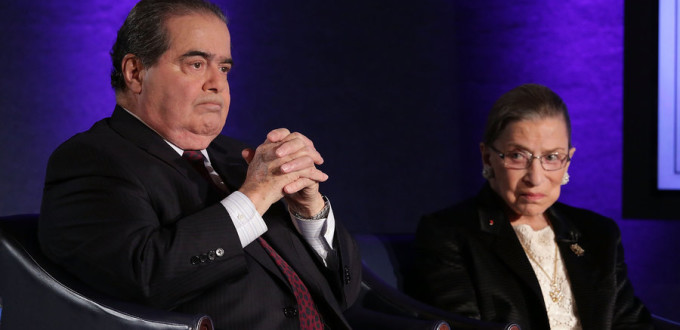
I sat as a member of Spectrum that day on the heels of Justice Antonin Scalia’s death. An incredibly smart and talented man known for his rhetorical abilities, Justice Scalia forever changed the face of the Supreme Court. Upon his death, he left an indelible impression on conservatism and the Supreme Court. Yet, although Justice Scalia was known for his originalist ideals, his best friend on the court was Justice Ruth Bader Ginsburg, a notably liberal-leaning justice. Although the two seldom agreed regarding matters of legal opinion, their friendship prospered.
Ginsburg noted this in a statement she released following Justice Scalia’s death. She wrote, “From our years together at the D.C. Circuit, we were best buddies. We disagreed now and then, but when I wrote for the Court and received a Scalia dissent, the opinion ultimately released was notably better than my initial circulation. Justice Scalia nailed all the weak spots—the “applesauce” and “argle bargle”—and gave me just what I needed to strengthen the majority opinion.”
Having been taken aback by the extent of the friendship between two people who I thought, given their differences, would probably not even be able to coexist, I began to reanalyze the way in which I looked at people whose opinions diverged from mine. Did I see them as less important? Did I push them away and discredit their opinion as inviable? Justices Ginsburg and Scalia saw each other as people first, regardless of their opinions, and they did not define each other by their opinions or ideologies.
I wanted to discuss this further with my peers. I felt as if our community could benefit from a discussion about respect for people’s opinions and the separation of person from opinion. I reached out to Kathryn Paravano, ’17, and Camilla Duke, ’16, two students who share a Scalia-Ginsburg friendship. Although the two differ politically, they are incredibly close friends who appreciate each other as people. I asked them about their sentiments regarding respect for political opinion in our community and how they, as such great friends, have been able to successfully separate opinion from the person.
Duke had an epiphany, a revelation regarding respect for differing views, during a private Question & Answer session with Justice Elena Kagan at a summer program for politics and public service Duke attended this summer:
“They have to understand, being Supreme Court Justices, that each Justice has good intentions and each Justice is extremely intelligent. Each Justice is there for a reason and was selected through the same system, and each of them is trying to do his or her job to the best of his or her ability. And while they would sometimes come to different conclusions, that would not detract from the fact that they were all doing their best to exercise [in the most fair way] the power that they were given as a Justice. I definitely had this moment, this epiphany. In politics in general, what tends to get lost in all of the chaos is that politics is about people. It’s about how to make government structures work best for all people–that is supposedly what we are all striving for. So, I often get confused when people forget about the humanity behind politics, because the ultimate goal is to make things best for people.”
Paravano chimes in, noting, “There are people in this school who have purposefully tried not to become friends with a person simply because of [her] political beliefs. They are both too staunch in their political beliefs to find common ground with the other. And that just isn’t what Stone Ridge is about. I don’t think that you should ever judge someone’s whole being just based on his or her beliefs. So, I think that it is sad to see that here. But overall, I think that Scalia and Ginsburg are a good model to show that people are people and their beliefs don’t define them.”
Talking with Paravano and Duke, amongst many other seniors in the Slounge, about this particular phenomenon, I realized how relevant this is to our community. More so than ever, amplified by the presidential campaign, I feel as if the Stone Ridge community is becoming increasingly more ideologically divided. We are forgetting to separate a person from his or her opinion.
Moreover, it is vital for us, as a community and as people, to understand that every single person’s opinion is valid and viable if it can be supported. Our inability to reconcile differences in opinion puts us in a very vulnerable position. Difference is conducive to enlightenment, education, and maturity. It is the differences that help us to better know and understand our own beliefs while still valuing the beliefs and opinions of others. We can’t shy or run away from difference–it should be celebrated.
Stone Ridge should be a place where all people can feel safe in being who they are. Republican or Democrat, pro-life or pro-choice, every member of the Stone Ridge community is entitled to his or her own opinion, and that opinion must be respected. That opinion must also be separated from the individual and should not detract from his or her humanity. Respect is simple, and it is something that we should practice every day. Stone Ridge gives us every avenue to do so, but it is something that we most certainly can work towards improving as a community.