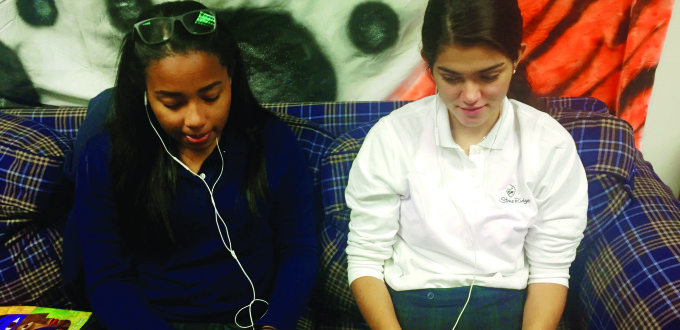
Can you imagine spending a single day without your phone? No way to communicate with your friends, unable to check if your favorite celebrity posted anything on social media. It’s pretty hard to envision, isn’t it? It’s undeniable that people spend a large amount of time on their phones. If you walk into the library before assembly, all the sophomores and freshmen are sitting in circles staring at their phone screens. Third and Fourth Academics can be found in the cloak rooms and the slounge, respectively, also plugged in to their phones. But is this really their fault?
Phones, and technology in general, have taken over our lives. Having this 24/7 access to a portable phone distracts us from our surroundings. Smart phones have everything and anything you could possibly imagine in a touch of a button. We are on our phones so much, because there is always something new that is being posted on social media. We never get tired of checking them.
If she ever got her phone taken away, Caroline Tangang, ’19, says, “I would get beyond anxious because all my streaks on Snapchat would go away, and Lord knows what would happen to One Direction if I left them for that day. Oh my goodness, I would probably die. I would not survive. I would not even think of getting a book; I would just look at the ceiling.” People get anxiety when they have spent just a couple of hours without looking at new posts on social media, because of the mentality of “I hav[ing] to be up to the minute with what is happening around the world, and what celebrities and friends are doing.”
Many think it is impossible to function in this world today without technology. Ines Andrés, ‘19, believes this is the case, because “everything these days is done through technology. To communicate with friends, make a doctor’s appointment, or make a reservation at a restaurant, you have to use your phone. Now, many high schools only accept electronic applications.” But it was not long ago that the only way to communicate with friends was through house phone lines, letters, pagers, and car phones. There were so many fewer distractions.
Camilla Duke, ’16, comments that the use of phones “is so normal in our society and in our culture that people don’t think twice about the value of face-to-face conversation and how they are detracting from it when they are on their phones, especially when they are just doing pointless stuff.” Now that Fourth Academics have only three months left at Stone Ridge, Duke, with a sudden frown on her face, says, “Senior year, I think it is important to spend time with your friends actually talking instead of being on your phone, because we only have so much time to hang out. Sorry that I got so sentimental, but it’s true!”
The average amount of hours spent on technology in our Stone Ridge community is 4 to 5 hours a day. Masuma Ahuja, a journalist for The Washington Post, found that teenagers consume more than 7.5 hours a day of technology. When asked about what she thought about this, Cheyenne Curley, ‘17, explains she was “not surprised because in our society, technology is basically a part of who we are and it is integrated in our school curriculum.”
Interestingly enough, the Waldorf School of the Peninsula in Silicon Valley, though very ironic in location, that leaves all screens outside the classroom. They go the old-fashioned way–pencil and paper. According to its website, “today’s children spend far less time than earlier generations engaging with other children, caring adults, and nature. The lure of electronic entertainment in our media-infused society influences the emotional and physical development of children and adolescents on many levels, and can detract from their capacity to create a meaningful connection with others and the world around them.” For this reason technology is not permitted in the school. Educators at this school “believe it is far more important for students to interact with one another and their teachers, and work with real materials than to interface with electronic media or technology.”
Though there is little to no proof of what the benefits of technology in the classroom are, schools still seem to be incorporating it in the student’s curriculum. Dr. Downey Vanover, Head of Word Languages at Stone Ridge, comments, “I agree 100% with the Waldorf School. Inside the world language classrooms, interactions between student [and] student and student [and] teacher is much more productive than screen time. But on the flip side, outside of class, there are great apps for language drill, practice, and different kinds of authentic resources.”
Many of those who excessively use their phones have a hard time realizing that their phones are an addiction. It is important to realize that your phone or laptop is not the only available entertainment. More and more people seem to be plugging in, and less and less seem to be unplugging and taking in their surroundings. Though it may not be easy to unplug initially, it is definitely possible.