By Ella Hartsoe
Young love. It’s a terrifying thought. All that hugging, kissing, googly eyes and make-out sessions in the rain. Long walks on the beach with drab dialogue about the existential realizations of 16-year-olds. It would make anyone want to throw up, frankly. But young adult fiction – specifically romance – is raking in capital for as long as one can remember. From “My only love sprung from my only hate!” to “Don’t let go, Jack” to “I wrote you, every dayyyy,” our culture seems pretty captivated by teenagers throwing themselves at each other and calling it true love.
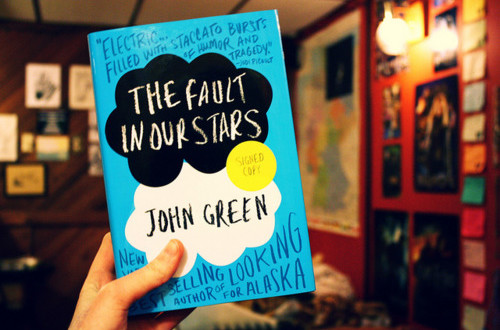
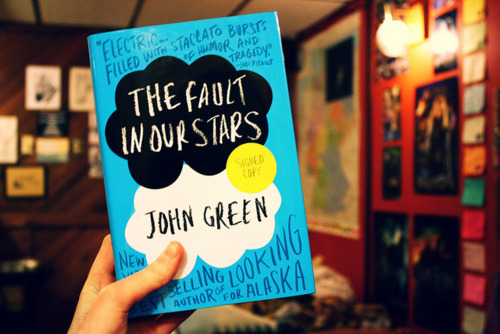
So let’s talk about our generations’ love story; the craze that’s gotten everyone sobbing on plane rides and movie theatres and fiercely yelling “Okay? OKAY” across middle school dance floors. John Green’s fantastically successful The Fault in Our Stars debuted almost two years ago, but it’s still worth talking about considering the amount of both criticism and love it continues to receive.
What’s not to love? Quirky, awkward, intelligent Hazel meets confident, funny, handsome Augustus at cancer support group because (you guessed it) they both have cancer. They fall madly in love as they run across the globe together on a wild goose chase to track down some hipster hermit author, who turns out not to live up to their expectations of being inspirational or insightful. Back to the United States where Hazel begins to watch her world crumble because (surprise, surprise!) these lovebirds’ young, passionate affair won’t last forever. Because, you know, they have cancer.
It’s tragic, funny, romantic, heart-wrenching, and sure, a little cliché. But above all The Fault in Our Stars is characterized by one of the biggest and baddest adjectives that can be used to describe young adult fiction: real. Like, grounded in cold, hard, realistic loss and grief, real.
Recall the moment when Hazel recites Eliot’s infamous “Let us go then, you and I/When the evening is spread out against the sky.” “The Love Song of J. Alfred Prufrock,” the poem that in this scene serves to bring Augustus and Hazel together, isn’t a poem about a happy relationship. It’s not even a poem about living vibrantly or in the moment.
At its conclusion, it reads “human voices wake us/and we drown,” and by the end of Green’s novel, Hazel is very much close to drowning, to dying because of these “human voices.” At least in its attempt to grapple with our generations’ overwhelming menaces, The Fault in Our Stars is a very real portrayal of the threats our generation must face, for better or worse.
There’s a valid argument against The Fault In Our Stars because at times Green’s characters are clichéd, one-dimensional, and even annoying. Many readers say they hateAugustus and Hazel who are so laser focused on their own “little infinity” (Green, 260); they seem to miss the dynamic world around their seemingly static relationship. Like many love stories, there is an expiration date on Hazel and Augustus’ relationship, and so, reminiscent of Romeo and Juliet, they must beat back time in order to hold each other for just one more moment.
But these faults of Hazel and Gus are real cracks that all teenagers, all people, have (they are not in the self, but, aptly, in the stars.) Hazel and Gus get wrapped up in their own fantasy because that’s how people sometimes act when they fall in love. There’s a power and a truth in Green’s portrayal of his two protagonists in such a traditional and clichéd way, even in the context of our modern and transitory lives. In the face of our everyday obstacles, Green insists on one truth above all others: everything, everyone — even consciousness itself — will end. So what are we to do in the face of this oblivion? How can we continue in the face of this overwhelming nihilism?
In attempting to address these questions, The Fault In Our Stars depicts a beautiful love story despite (or perhaps because of) its fleeting nature. For Green, and hopefully for his audience, beauty and love and purpose lie in our most transitory and intimate relationships, in all of our own “little infinites.” Our continuation in spite of oblivion means that complete darkness may never come and that hope may lie in a single spark between two star-crossed lovers.
Leave a Reply