Goal 2 of Sacred Heart education promotes “a deep respect for intellectual values.” How can you respect and understand said intellectual values if you’re not holistically exposed to them? How can you properly incorporate “all forms of critical thinking,” as stated within the criteria of Goal 2, without exposure to them?
I urge you to imagine learning in an entirely homogeneous place, with people who share the same experiences and opinions, who look identical to each other. Any dialogue between those people would be mundane, insipidly uniform; it would create an echo chamber of sorts–a reinforcement of the same belief system.
Now, I encourage you to imagine learning while surrounded by both likeminds and dissenters. Discussion amongst this group would revel in disagreement, inflaming the need for mutual respect and understanding. I believe that while the former learning style stifles students and their thought processes, the latter is the educational environment that cultivates genuine personal conviction.
Stone Ridge is cognizant of this necessary exposure. Says Dr. Perez-Caro, Director of Diversity, “At Stone Ridge, our student body comes from a variety of religious, racial, and socioeconomic backgrounds within a 50-mile radius of Bethesda, Maryland, reflecting the rich diversity of our dynamic region. Our Diversity Education Program works to align with the goals and criteria in specific ways: by fostering ‘inter-religious acceptance and dialogue for deep respect of the world religions,’ utilizing ‘a variety of teaching and learning strategies that recognize the individual needs of our students,’ partnering with the Social Action Program to ‘prepare students to be active, informed, and responsible citizens,’ [and] intentionally ‘promoting a safe and welcoming environment in which each person is valued, cared for, and respected.’ It collaborates with Admissions, Formation to Mission and Campus Ministry, Operations, and Professional Development to attract families, students, and employees reflecting our region’s racial, ethnic, familial, and socioeconomic diversity.”
Dr. Perez-Caro then continues to explain that, “At Stone Ridge and in accordance with the National Association of Independent Schools (NAIS), we understand diversity to mean the range of identities and experiences that individuals, groups, and communities share, and equity as the act of intentionally supporting all students and community members.”
Even The Here & Now exemplifies a need for ideological variation, serving in part as an open forum that showcases the incredibly diverse thinking that typifies our campus, in tangible form. I first experienced the excitement of published work in my third grade classroom with Mrs. Reis–compiling my classmates’ poems, illustrations, and general thoughts, I successfully created my first “newspaper.” Until that moment, I had never taken as much pride in my work, not because this compilation was the most visually appealing–resulting from my poor cutting skills–but because it was my first assemblage of sincere self-expression and conviction. Understanding my schoolmates’ opinions and helping them amplify and broadcast their own unique voices to the larger community was an inspiring experience in the third grade, and still is now, as a Fourth Academic. What would our school be without those formatively unique voices?
In the world of news, education, and politics, improving educational opportunities for historically underrepresented minority groups is referred to as affirmative action. Since desegregation, affirmative action has allowed enrollment rates of women, African-Americans, and Hispanics to steadily increase. According to the National Center on Education Statistics, in 2007, while 70% of white students enrolled in college immediately following high school graduation, a mere 56% of African-American students and 61% of Hispanic students enrolled in college immediately. Race is often still linked to socioeconomic status; more African-American and Hispanic students are underprivileged or even impoverished, and are therefore disadvantaged by a lack of resources. Proponents of affirmative action claim that it accounts for economic disparity.
However, maintain opponents of affirmative action, why should an affluent black or Hispanic student, who has confronted no economic adversity, have an upper hand in the college admissions process? When there exists no economic disparity, why, for example, should that student belonging to a racial minority be accepted over an equally qualified white student?
Delia Friel, ‘16, cites socioeconomics as the only factor she believes should be considered during affirmative action. “I don’t agree with affirmative action based on race,” says Friel. “I think affirmative action should be based on socioeconomic status, as well as if you’re the first generation in your family to go to college. I think that socioeconomic status really correlates to having to work harder in order to arrive at success. I do think that students who have had to overcome more boundaries, barriers, and obstacles, should be given this booster, just because they’ve worked so hard. However, I do not think that basing preference on race necessarily correlates [to] a student being disadvantaged.”
Ms. Ciccone, Director of College Counseling, explains the stance of many college admissions offices by saying that, “Affirmative action can be very helpful in college admissions, as colleges actively recruit students of color, enabling them to create a diverse campus that reflects our diverse world. Colleges want their students from around the country and around the world, from varying religions, races, cultures, ethnic backgrounds, and socioeconomic statuses, so that all students may engage [with], interact [with], and learn from students unlike themselves.”
It’s no secret that race naturally correlates to personal experience. Maya Moore, ‘16, supports this by referring to the “invisible backpack we discussed in morality last year.” As an African-American student, she “encounter[s] different things. Even the simple things, like [her] hair, fascinates other people.” She then notes, “I might go to the store, and certain [items of clothing] won’t match my skin tone. I might even walk in a store and feel as though the sales person is looking at me differently, and I might just feel like that’s based on my color. I just see the world a bit differently and have a unique perspective.”
Therefore, though both teenage college applicants and the Supreme Court may contend over whether or not economic disparity should be regarded during college admissions, it remains my firm belief that diversity molds a college campus. It literally molds its conglomerate of students, but it also molds the experiences students have inside and outside of the classroom.
One of the reasons that I support affirmative action is that it has supported qualified women throughout history, aiding them in taking their deserved places in higher education and the workforce. Specifically in education, affirmative action has greatly benefitted women in traditionally male-dominated fields, such as science, technology, engineering, and math (or STEM).
It also remains my firm belief that colleges should aim to replicate the community that surrounds them–if that community is 20% African-American, so should that local college’s student body. That student body should serve as a microcosm of the larger community. If creating such a microcosm calls for affirmative action, so be it. I think sometimes we fail to recognize that college is not merely marked by test scores–even more so by different encounters, different voices. So if a student has a lower test score than another but an unbelievably incredible story, that story will take that student and that college further than 100 additional points on the SAT.
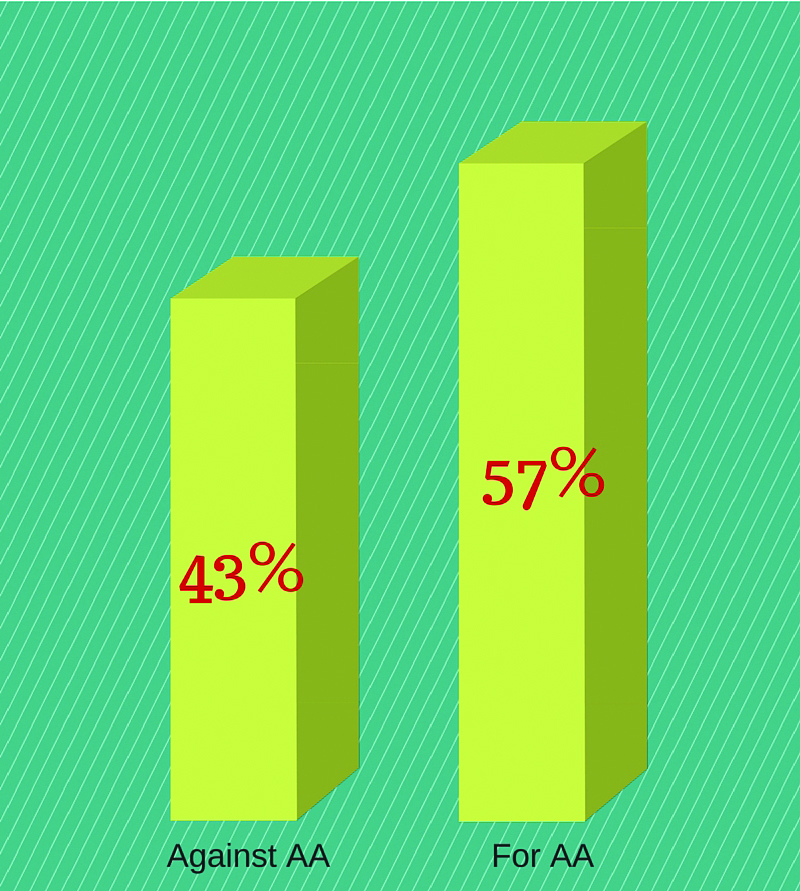
I urge you to return to my initial question, to consider the two learning environments, and decide for yourself where you stand on this divisive issue. But in doing so, I also implore you to consider that affirmative action’s primary aim is to account for unheard voices in addition to economic disparity.