
Dressing up like a princess seems like such harmless fun — or at least this is what Michel le Parmentier, director of France’s “Mini-Miss” pageants, would have you believe. His annual competition for preteens has come under fire in recent years, blurring the line between what is seen as “cute” and “sexual,” leaving French citizens concerned for their impressionable young girls.
The outcries of both supporters and opponents have grown increasingly loud and impassioned as a bill has moved through the French Senate, championed by Senator Chantal Jouanno, with the intent of banning the competitions as part of a women’s rights initiative.
Senator Jouanno, a mother of three, proposed her bill after French Vogue published what some called “hyper-sexualized” spreads of then ten-year-old model Thylane Blondeau. With a sexy pout, plunging neckline and a pair of heels, Blondeau’s photographs gave off a disturbing illusion of maturity.
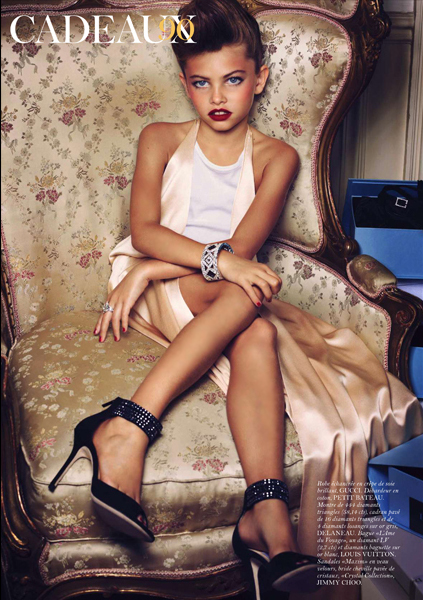
As students in an all girls’ school, it’s important to consider the implications of this bill– is the French Senate actually protecting women or is it simply placing more restrictions upon them? To answer this pressing question, one must consider both sides of the argument.
As Dr. Jean Paul Penner stated in an interview with NPR, “[pageants] give a very sexualized image of kids who aren’t even in puberty… in doing so, [they] contradict the normal and harmonious development of a child.” Essentially, opponents argue that exposing a child to a world where superficial beauty, not intellect or personality, is rewarded teaches a child that they are nothing more than their subjective, transient appearance. This lesson is so easy to learn and so difficult to forget. Not only are young children impressionable, but girls are also conditioned to be sensitive to comments surrounding beauty by a culture fixated on physical self-improvement and unattainable perfection.
In a study conducted by the National Institutes of Health, a group of eleven women, all former child pageant contestants, were compared with a group of eleven non-contestants of similar age and body type. The former contestants were found to be more susceptible to what the 2005 report described as “body dissatisfaction, interpersonal distrust and lack of impulse control.” However, as pageantry supporters often cite, the study did not show that this group was actually at any higher risk of eating disorders such as anorexia or bulimia.
In her research, Senator Jouanno found that French cultural norms around sexuality extend so far into early childhood that they could be considered a “form of violence” against children. In an interview with PBS, she cited reports from the World Health Organization that found that twenty-seven percent of eleven-year-old European girls consider themselves to be “too fat.” Forty percent of girls around the age of fifteen feel similarly.
Senator Jouanno’s bill includes a series of recommendations that serve as protective measures such as the prohibition of commercial child spokesmodels, the outlawing of adult clothes made available in child sizes (like push-up bras and heels) and the formation of an internet platform to identify companies that have failed to comply with the aforementioned conditions.
In the same PBS interview, Jouanno stressed that she is not opposed to childhood competitions based on talent. She herself began competing in karate championships at a young age and believes that such activities foster pride and dedication, only becoming dangerous when physical appearance is considered as the only qualifying merit. However, involved parents and their competing children claim that pageants reward far more than just beauty; poise, elegance and public speaking abilities are also deciding factors. At worse, participants are accused of playing mere dress up in front of a crowd. But most involved parents believe that the girls are embracing their femininity with a pride and gusto found in few other activities. They are taught to win with dignity and to lose with grace and, in France, to do so without makeup or provocative dress.
Sociologist Michel Frize, who studies adolescent development, argues that while hyper-sexualization is a very real threat in French culture, pageants are simply not part of the issue because “little girls don’t see themselves as objects. They don’t see themselves as unequal to boys. They are just proud to be feminine.” With more than 5,000 pageants held each year around the world that involve almost 250,000 children, many people agree with and endorse the industry’s benefits and, by extension, feel attacked by Senator Jouanno’s bill. The outcries of those on both sides of the argument often eclipse those of the young girls who are at the receiving end of a culture bombarded by sexuality.
Many of these girls are just trying to figure out what exactly it means to be feminine.
Leave a Reply